


Quick answer
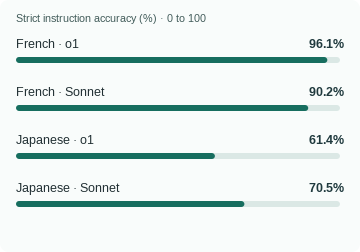
In M-IFEval’s language-specific instructions, OpenAI o1 led Claude 3.5 Sonnet by 5.9 percentage points in French. Sonnet led o1 by 9.1 points in Japanese. The ranking swung 15.0 points between those comparisons. A checkout team expanding to a new market should test the constraints specific to that locale before relying on a general language score.
Key findings and sources
French and Japanese locale-specific results reversed the ranking
On M-IFEval’s 2025 strict locale-specific subsets, o1 scored 96.1% and Claude 3.5 Sonnet 90.2% in French. In Japanese, Sonnet scored 70.5% and o1 61.4%. The model margin swung by 15.0 percentage points.
Dussolle and colleagues, M-IFEval, NAACL Findings 2025
Overall and locale-specific Japanese results differed
In M-IFEval, o1’s reported strict Japanese score was 75.7% overall and 61.4% on Japanese-specific instructions, a descriptive 14.3-point gap. Sonnet’s equivalent values were 77.0% and 70.5%, a 6.5-point gap.
Dussolle and colleagues, M-IFEval, NAACL Findings 2025
The Spanish subset had its own margin
On M-IFEval’s strict Spanish-specific instructions, o1 scored 75.0% and Claude 3.5 Sonnet 66.7%, an 8.3-point gap. The comparison is specific to the benchmark’s Spanish instruction subset.
Dussolle and colleagues, M-IFEval, NAACL Findings 2025
Verifiable instruction following is narrower than checkout accuracy
M-IFEval’s authors scored objectively checkable instructions. Its published strict scores do not measure translation quality, factual support answers or the success of retail checkout conversations.
Dussolle and colleagues, M-IFEval, NAACL Findings 2025
Looser scoring widened the Japanese locale-specific ranking gap
On M-IFEval’s Japanese locale-specific instructions, Sonnet led o1 by 9.1 points under strict scoring and 12.5 points under loose scoring. The ranking stayed the same across the two reported grading rules.
Dussolle and colleagues, M-IFEval, NAACL Findings 2025
2025 M-IFEval Japanese-specific instruction subset, named model configurations. Subtract o1 from Sonnet in each of the strict and loose Japanese columns.
The same model’s grading gap varied across two locales
For Sonnet on M-IFEval’s locale-specific subset, loose scores exceeded strict scores by 8.3 points in Spanish and 5.6 points in Japanese.
Dussolle and colleagues, M-IFEval, NAACL Findings 2025
2025 M-IFEval locale-specific instruction subset, Sonnet model. Subtract the strict score from the loose score within each locale.
Compare the results
A fluent answer can still break a checkout rule
A team expanding from an English-language store may translate its test prompts and check that the replies read naturally. That catches some problems. It does not tell you whether the reply preserves a delivery option’s local name, uses the checkout’s actual currency or asks for a postal code in the form your order system expects. Those conditions need their own pass criteria.
M-IFEval makes that distinction measurable for an instruction benchmark. Its strict scores on the overall Japanese set were 77.0% for Claude 3.5 Sonnet and 75.7% for o1. On instructions specific to Japanese, the scores were 70.5% and 61.4%. The within-model gaps were 6.5 and 14.3 points. The subsets differ in composition, so the gaps show how much the headline can hide rather than the effect of one instruction change.
Model order can reverse when the rule changes
In the locale-specific French subset, o1 reached 96.1% and Sonnet 90.2%. In the Japanese subset, the order flipped. The margin shifted from a 5.9-point lead for o1 to a 9.1-point lead for Sonnet, a 15-point swing. That comparison is more useful for locale test design than treating a cross-language average as a universal ranking.
The paper scores constraints that can be checked by code. It cannot tell you which model is better at explaining a warranty or handling a frustrated shopper. Use the measurement idea. Check separately whether the answer follows hard checkout requirements and whether a native reviewer understands and trusts the explanation.
Choose two kinds of locale tests before you open the queue
Start with matched examples that should resolve identically across markets, such as a question about the exact SKU listed in the cart. Then add cases that should resolve differently, such as a destination-dependent shipping promise, a localized size convention or a payment method only available for that storefront. Keep the accepted values beside the exact source record.
Automate checks on identifiers, currency and available fulfillment options. Ask a native reviewer to assess customer-facing language, especially for cases where you decline an exception or cannot confirm a date. Grade when the assistant needs a clarification and whether it asks for only the missing piece. Record separate scores by locale and error type so a strong market cannot hide a failed requirement in another.
The scorer changed the size of the Japanese lead
On the Japanese locale-specific instructions, M-IFEval reported strict scores of 70.5% for Sonnet and 61.4% for o1. Under the appendix’s loose scoring, the two rows rose to 76.1% and 63.6%. The Japanese lead stays with Sonnet and grows from 9.1 to 12.5 points. Sonnet gained 5.6 points under the relaxed scorer and o1 gained 2.2. On Sonnet’s Spanish locale-specific row the strict-to-loose increase was 8.3 points.
These are instruction-following scores for published model configurations. They show what changes when the authors switch scoring rules for the same benchmark subset. They cannot tell us whether any extra accepted answer would correctly handle duties, checkout currency or a delivery commitment.
An overall multilingual average can weight languages and instructions differently from a store’s queue. Before launch, record the active locales and the transaction checks each one needs. Compare scores at the same test difficulty and report any tiny locale subset separately rather than letting the higher-volume market hide its failures.
Choose which checkout details must be right even when the wording varies
Allow several natural ways to phrase a verified pickup window or explain a return. Keep exact checks for the promised date, eligible market, tax treatment and the amount the shopper will pay. A response can use local phrasing while still applying the wrong market’s policy. A rigid textual match can also reject a correct answer because the phrasing differs.
For each locale, maintain a pair of test outcomes: whether the answer is semantically helpful and whether its operational values pass the strict checks. Let a style reviewer accept alternate wording only after the amounts and eligibility conditions agree with the source record. If a translated answer fails an exact value check, investigate the underlying policy lookup or order state before changing the translation prompt.
Give the language reviewer a second reference when a policy value varies by market. They should be able to check the current source even if the generated answer sounds natural. If a wording change passes the relaxed score and fails the exact product or price check, keep the operational result visible and fix it before relying on the relaxed score.
Study data
| Measure | Value | Context |
|---|---|---|
| OpenAI o1 all English strict score | 86.7% | Published strict score on original English IFEval |
| OpenAI o1 all Spanish strict score | 92.7% | Published strict score on full language evaluation set |
| OpenAI o1 all French strict score | 91.3% | Published strict score on full language evaluation set |
| OpenAI o1 all Japanese strict score | 75.7% | Published strict score on full language evaluation set |
| OpenAI o1 locale-specific Spanish strict score | 75% | Published strict score on locale-specific instructions only |
| OpenAI o1 locale-specific French strict score | 96.1% | Published strict score on locale-specific instructions only |
| OpenAI o1 locale-specific Japanese strict score | 61.4% | Published strict score on locale-specific instructions only |
| Claude 3.5 Sonnet all English strict score | 88.1% | Published strict score on original English IFEval |
| Claude 3.5 Sonnet all Spanish strict score | 87.6% | Published strict score on full language evaluation set |
| Claude 3.5 Sonnet all French strict score | 88.1% | Published strict score on full language evaluation set |
| Claude 3.5 Sonnet all Japanese strict score | 77% | Published strict score on full language evaluation set |
| Claude 3.5 Sonnet locale-specific Spanish strict score | 66.7% | Published strict score on locale-specific instructions only |
| Claude 3.5 Sonnet locale-specific French strict score | 90.2% | Published strict score on locale-specific instructions only |
| Claude 3.5 Sonnet locale-specific Japanese strict score | 70.5% | Published strict score on locale-specific instructions only |
| Claude 3.5 Opus all English strict score | 87.3% | Published strict score on original English IFEval |
| Claude 3.5 Opus all Spanish strict score | 90.5% | Published strict score on full language evaluation set |
| Claude 3.5 Opus all French strict score | 87% | Published strict score on full language evaluation set |
| Claude 3.5 Opus all Japanese strict score | 75.7% | Published strict score on full language evaluation set |
| Claude 3.5 Opus locale-specific Spanish strict score | 62.5% | Published strict score on locale-specific instructions only |
| Claude 3.5 Opus locale-specific French strict score | 90.2% | Published strict score on locale-specific instructions only |
| Claude 3.5 Opus locale-specific Japanese strict score | 64.8% | Published strict score on locale-specific instructions only |
| GPT-4o all English strict score | 88.6% | Published strict score on original English IFEval |
| GPT-4o all Spanish strict score | 89.8% | Published strict score on full language evaluation set |
| GPT-4o all French strict score | 87.8% | Published strict score on full language evaluation set |
| GPT-4o all Japanese strict score | 70.4% | Published strict score on full language evaluation set |
| GPT-4o locale-specific Spanish strict score | 58.3% | Published strict score on locale-specific instructions only |
| GPT-4o locale-specific French strict score | 80.4% | Published strict score on locale-specific instructions only |
| GPT-4o locale-specific Japanese strict score | 55.7% | Published strict score on locale-specific instructions only |
| OpenAI o1 locale-specific French loose score | 100% | Published average loose instruction-following score. |
| OpenAI o1 locale-specific Japanese loose score | 63.6% | Published average loose instruction-following score. |
| Claude 3.5 Sonnet locale-specific Japanese loose score | 76.1% | Published average loose instruction-following score. |
| Claude 3.5 Sonnet locale-specific Spanish loose score | 75.0% | Published average loose instruction-following score. |
What changes when you compare the figures
| Comparison | Result | Calculation |
|---|---|---|
| OpenAI o1 French lead on locale-specific instructions | 5.9 percentage points | = 96.1 - 90.2 |
| Claude 3.5 Sonnet Japanese lead on locale-specific instructions | 9.1 percentage points | = 70.5 - 61.4 |
| Magnitude of the French-to-Japanese reversal | 15 percentage points | = (96.1 - 90.2) + (70.5 - 61.4) |
| OpenAI o1 overall Japanese minus locale-specific Japanese score | 14.3 percentage points | = 75.7 - 61.4 |
| Claude 3.5 Sonnet overall Japanese minus locale-specific Japanese score | 6.5 percentage points | = 77.0 - 70.5 |
| GPT-4o overall Japanese minus locale-specific Japanese score | 14.7 percentage points | = 70.4 - 55.7 |
| OpenAI o1 Spanish lead over Claude 3.5 Sonnet | 8.3 percentage points | = 75.0 - 66.7 |
| Loose versus strict Japanese uplift for o1 | 2.2 percentage points | = 63.6 - 61.4 |
| Loose versus strict Japanese uplift for Sonnet | 5.6 percentage points | = 76.1 - 70.5 |
| Sonnet lead on Japanese locale-specific loose scoring | 12.5 percentage points | = 76.1 - 63.6 |
| Loose versus strict Spanish uplift for Sonnet | 8.3 percentage points | = 75 - 66.7 |
Methodology and sources
Read the average strict scores in Tables 1 and 2. Compare models within the same locale-specific subset. Compute overall-minus-subset differences within the same model and language as descriptions of sample composition, without interpreting the subgroup comparison as a causal penalty. The English IFEval values are a separately reported reference and were not used in the cross-language ranking calculations. The benchmark scores verifiable instructions, not production conversations, translation accuracy or order outcomes.
Download the source data (CSV)
Download the calculations (CSV)
Related reading
AI multi-turn conversation reliability statistics
AI context length accuracy statistics from the RULER benchmark
Sources and definitions
Dussolle and colleagues, M-IFEval, NAACL Findings 2025
The source data includes the population, period, denominator and limitations for every figure.