


Quick answer
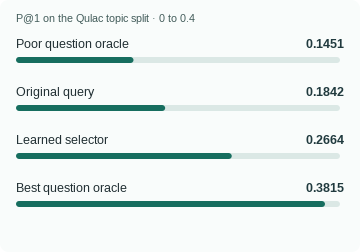
In the 2019 Qulac topic split, the original query had a precision-at-one score of 0.1842. The study’s question selector raised it to 0.2664 after the selected question was answered. An oracle-selected poor question reduced it to 0.1451. In the authors’ per-facet analysis, asking improved 45% of facets and worsened 19%.
Aliannejadi et al., Asking Clarifying Questions in Open-Domain Information-Seeking Conversations
Key findings and sources
Learned clarification improved top-ranked retrieval
In Aliannejadi et al.’s 2019 Qulac topic split, precision at rank one was 0.1842 for the original query and 0.2664 after the learned NeuQS selector’s clarification was answered, an 8.22-percentage-point difference on the retrieval benchmark.
Aliannejadi et al., Asking Clarifying Questions in Open-Domain Information-Seeking Conversations
A poor clarification can do worse than the original query
In the Qulac topic split, the worst-question oracle scored 0.1451 on P@1 versus 0.1842 for the original query, 3.91 percentage points lower. The oracle selects in hindsight and is not a field estimate of assistant behavior.
Aliannejadi et al., Asking Clarifying Questions in Open-Domain Information-Seeking Conversations
How much of the oracle gain the learned selector captured
On the Qulac topic split, the learned selector captured about 41.66% of the P@1 improvement between the original query, 0.1842, and the best-question oracle, 0.3815. The best-question oracle uses the answer and the outcome in hindsight.
Aliannejadi et al., Asking Clarifying Questions in Open-Domain Information-Seeking Conversations
Clarifications did not improve every facet
In Aliannejadi et al.’s Qulac analysis, NeuQS improved retrieval performance on 45% of the examined facets and worsened it on 19%. These are facet-level benchmark outcomes, not store resolution or conversion rates.
Aliannejadi et al., Asking Clarifying Questions in Open-Domain Information-Seeking Conversations
What the clarification dataset contained
The 2019 Qulac inventory reports 198 search topics, 762 facets, 2,639 clarifying questions and 10,277 question-answer pairs. The dataset was assembled for open-domain document retrieval.
Aliannejadi et al., Asking Clarifying Questions in Open-Domain Information-Seeking Conversations
How close the selectors looked depended on the retrieval metric
In the Qulac topic split, QPP retained about 94.0% of NeuQS’s gain over the original query on mean reciprocal rank and 85.9% of its gain on precision at one. These are descriptive ratios from the published retrieval table.
Aliannejadi et al., Asking Clarifying Questions in Open-Domain Information-Seeking Conversations
The worst clarification lowered first-result precision while the deeper metric rose slightly
In Qulac Table 3, the worst-question oracle moved P@1 from 0.1842 to 0.1451 while nDCG@20 moved from 0.1470 to 0.1483 compared with the original query. The two measures use different ranking cutoffs and scoring rules.
Aliannejadi et al., Asking Clarifying Questions in Open-Domain Information-Seeking Conversations
Qulac information retrieval benchmark, original-query and worst-question oracle rows. Compare the displayed original and oracle rows separately for P@1 and nDCG@20.
The learned clarifier improved the deeper ranking measure on the facet split
In Qulac’s facet split, NeuQS raised nDCG@20 from 0.1470 for the original query to 0.1867, a gain of 0.0397 on the published score scale.
Aliannejadi et al., Asking Clarifying Questions in Open-Domain Information-Seeking Conversations
Qulac-F retrieval setting, learned question selector compared with the original query. Subtract the original-query nDCG@20 value from the NeuQS nDCG@20 value.
Compare the results
The first question has to change the answer
The Qulac study starts with an open-domain query, a candidate clarification and an annotated answer. On the topic split, its learned selector moved P@1 from 0.1842 to 0.2664, an 8.22-point gain. The benchmark asks whether the top-ranked document is relevant. It does not tell a shop how often an assistant will answer a buyer correctly or whether the buyer will purchase.
The operational question transfers even when the numbers do not. Imagine that a shopper says a discount is missing. The item, destination and timing are already known, but the system cannot tell whether the shopper wants to apply a code or is asking about an advertised sale. That missing condition changes which records to check and what the assistant can say. One question to distinguish those cases can be useful. Asking the shopper to repeat the order reference when the correct order is already identified adds friction without resolving the difference.
Treat the answer as a new fact and read it back against the action being considered. If the shopper gives a code, inspect the current eligibility and the active cart. If the shopper points to a sale page, verify the displayed price and timing. A clear answer to the wrong question still creates work.
A poor clarification can make retrieval worse
The same evaluation included oracles that select the best or worst candidate using its answer and retrieval outcome. Their P@1 scores were 0.3815 and 0.1451, a span of 23.64 points. The worst result was 3.91 points below using the original query alone. These deliberately extreme choices show the cost of question quality. They do not estimate how frequently an ordinary assistant will select either extreme.
Across the authors’ facet analysis, 45% improved and 19% worsened. Subtracting those reported rounded shares leaves about 36% outside either category. A question that helps in the aggregate can hurt on a meaningful portion of cases. The experiment also includes answers that negate a bad assumption. The response still has to use the negation and any new facts accurately.
One store test should therefore contain answerable requests, underspecified requests and misleading cases that sound answerable. For each, score a direct answer, a clarification and an escalation against the same verified product and order evidence. Track whether the question supplied a decision-changing fact and whether the next answer actually used it.
Measure the value of the question alongside its cost
NeuQS captured about 41.66% of the P@1 gap between the original query and the best-question oracle. The model earned a gain without knowing the answer at selection time. The oracle has information a real assistant lacks. Use the gap to ask where a better question or a better retrieval rule might help, rather than treating the oracle as a product target.
For checkout, judge the final result by issue resolution and correct action, then show how many turns it took and how often customers left without resolving the issue. A shorter interaction can be better if it uses a verified answer already available. A longer one is worthwhile when the missing detail would change eligibility, compatibility or a paid action.
Set a fallback for the case where the question does not resolve the uncertainty. Offer the relevant policy condition, a reversible option or human help when appropriate. A second generic question should not be the default. Repeated asking can hide a system that is unable to use the information it already has.
Pick the clarification selector for the result the shopper needs
In the Qulac topic split, the QPP selector improved mean reciprocal rank by 0.0855 over the original query. NeuQS improved it by 0.0910, so the QPP selector captured about 94.0% of the learned selector’s gain on that measure. For precision at one, the gains were 0.0706 and 0.0822, or about 85.9%. Two selectors can look close on an average rank measure and farther apart when only the first answer matters.
Which metric should a checkout team prefer? For a request such as finding which charger fits a device, the first recommendation often has to be right. A correct accessory further down a list can still leave the shopper with a wrong item. For a broader question such as which fabrics are suitable for summer, a useful set of options may matter more than a single top result.
Write the scoring criterion before picking the question selector. Give the system a request with one necessary missing fact, one where enough information is already present and one it cannot resolve without a person or fresh data. For the first group, grade both whether the question gathers the needed fact and whether the first subsequent answer is valid. For the second, penalize needless delay. In the third, reward an honest handoff that carries forward what the shopper already explained.
Choose the ranking cutoff that matches what the shopper will see
The Qulac worst-question oracle lowered precision at rank one from 0.1842 to 0.1451. Its nDCG at rank 20 moved from 0.1470 to 0.1483. That is a 3.91-point loss on the first-result precision scale alongside a 0.0013 increase in the deeper ranking metric. The deeper metric rewards graded relevance across more results. It can improve slightly while the top result gets worse.
NeuQS on the facet split raised nDCG at 20 from 0.1470 to 0.1867, a gain of 0.0397. A ranking gain in this benchmark is a reason to test the clarification method. The shopper may only see one suggested size or one direct link in a text conversation. In that setting, the quality of the first usable result deserves its own measure.
The oracle rows are research bounds because the selection has access to information a deployed assistant does not know. Compare deployed selectors only against alternatives with the same available evidence. When a small score gain depends on a later answer or an unavailable intent label, report it as an opportunity to improve selection rather than an expected result.
Keep an honest comparison when the reply includes several options
If the user asks for the exact available replacement, judge the first suggestion against their size, material or compatibility requirement. If they ask to browse choices, score whether several options cover the stated constraints and explain their differences. Label these request types before testing so a new question strategy cannot change what counts as success mid-test.
Use a no-question comparison and record which information the clarifier resolves. If an order record already supplies the answer, the extra turn can delay a correct recommendation. If the buyer must choose between several valid possibilities, one precise question can improve the first result. The test should count the number of useful turns and the actual resolution as well as ranking scores.
Hold response latency and the number of visible options constant when testing a different question strategy. A second click or message may be worthwhile when it prevents ordering an incompatible item. A narrower example where all options meet the requirement helps distinguish actual improvement from a tendency to ask more questions in every conversation.
Study data
| Measure | Value | Context |
|---|---|---|
| Original query, MRR | 0.2715 score out of 1 | Mean reciprocal rank |
| Original query, P@1 | 0.1842 score out of 1 | Precision at rank one |
| Original query, nDCG@1 | 0.1381 score out of 1 | Graded ranking score at one result |
| QPP selector, MRR | 0.357 score out of 1 | Mean reciprocal rank |
| QPP selector, P@1 | 0.2548 score out of 1 | Precision at rank one |
| QPP selector, nDCG@1 | 0.196 score out of 1 | Graded ranking score at one result |
| NeuQS topic split, MRR | 0.3625 score out of 1 | Mean reciprocal rank |
| NeuQS topic split, P@1 | 0.2664 score out of 1 | Precision at rank one |
| NeuQS topic split, nDCG@1 | 0.2064 score out of 1 | Graded ranking score at one result |
| NeuQS facet split, MRR | 0.3641 score out of 1 | Mean reciprocal rank |
| NeuQS facet split, P@1 | 0.2682 score out of 1 | Precision at rank one |
| NeuQS facet split, nDCG@1 | 0.211 score out of 1 | Graded ranking score at one result |
| Worst-question oracle, MRR | 0.2479 score out of 1 | Mean reciprocal rank |
| Worst-question oracle, P@1 | 0.1451 score out of 1 | Precision at rank one |
| Worst-question oracle, nDCG@1 | 0.1075 score out of 1 | Graded ranking score at one result |
| Best-question oracle, MRR | 0.4673 score out of 1 | Mean reciprocal rank |
| Best-question oracle, P@1 | 0.3815 score out of 1 | Precision at rank one |
| Best-question oracle, nDCG@1 | 0.3031 score out of 1 | Graded ranking score at one result |
| Topics in Qulac | 198 topics | 141 faceted and 57 ambiguous topics |
| Question-answer pairs in Qulac | 10,277 pairs | Annotated question-answer pairs |
| Facets with improved reciprocal-rank outcome | 45% | NeuQS improved versus OriginalQuery |
| Facets with worse reciprocal-rank outcome | 19% | NeuQS was worse versus OriginalQuery |
| Facets in Qulac | 762 facets | Distinct topic facets |
| Clarifying questions in Qulac | 2,639 questions | Distinct questions |
| No-question nDCG at 20 | 0.147 score out of 1 | Published score at rank cutoff 20. |
| Worst-question oracle nDCG at 20 | 0.1483 score out of 1 | Published score at rank cutoff 20. |
| Learned selector nDCG at 20 | 0.1867 score out of 1 | Published score at rank cutoff 20. |
What changes when you compare the figures
| Comparison | Result | Calculation |
|---|---|---|
| Learned selector gain over original query on P@1 | 8.22 percentage points | = (0.2664 - 0.1842) * 100 |
| Original query minus poor-question oracle on P@1 | 3.91 percentage points | = (0.1842 - 0.1451) * 100 |
| Distance between best and worst question oracles on P@1 | 23.64 percentage points | = (0.3815 - 0.1451) * 100 |
| Learned selector share of best-question P@1 gain | 41.66 % of oracle gain | = (0.2664 - 0.1842) / (0.3815 - 0.1842) * 100 |
| QPP selector gain over original query on P@1 | 7.06 percentage points | = (0.2548 - 0.1842) * 100 |
| Share of facets not classified as improved or worsened | 36% | = 100 - 45 - 19 |
| QPP share of NeuQS improvement over original query on MRR | 93.96% | = (0.3570 - 0.2715) / (0.3625 - 0.2715) * 100 |
| QPP share of NeuQS improvement over original query on precision at one | 85.89% | = (0.2548 - 0.1842) / (0.2664 - 0.1842) * 100 |
| NeuQS precision-at-one advantage over QPP | 0.0116 score out of 1 | = 0.2664 - 0.2548 |
| Worst-question oracle P@1 change relative to no question | -3.91 percentage points | = (0.1451 - 0.1842) * 100 |
| Worst-question oracle nDCG@20 change relative to no question | 0.0013 nDCG score | = 0.1483 - 0.1470 |
| NeuQS nDCG@20 gain over no question, facet split | 0.0397 nDCG score | = 0.1867 - 0.1470 |
| Relative nDCG@20 gain from NeuQS on the facet split | 27.01% | = (0.1867 - 0.1470) / 0.1470 * 100 |
Methodology and sources
We transcribed the named rows of Tables 1 and 3 and the authors’ per-facet result in Section 6.2. OriginalQuery, the learned selector NeuQS and the best and worst candidate-question oracles are separate. The chart and all differences use the topic-held-out split; the facet-held-out row is shown separately. We multiply P@1 differences by 100 to report percentage points. Oracles choose with the benefit of answers and measured retrieval outcomes. They are diagnostic boundaries, not deployable question selectors. No ecommerce sessions were analyzed.
Download the source data (CSV)
Download the calculations (CSV)
Related reading
AI multi-turn conversation reliability statistics
AI context length accuracy statistics from the RULER benchmark
Multilingual AI checkout statistics for locale-specific instruction following
Sources and definitions
Aliannejadi et al., Asking Clarifying Questions in Open-Domain Information-Seeking Conversations
The source data includes the population, period, denominator and limitations for every figure.