


Quick answer
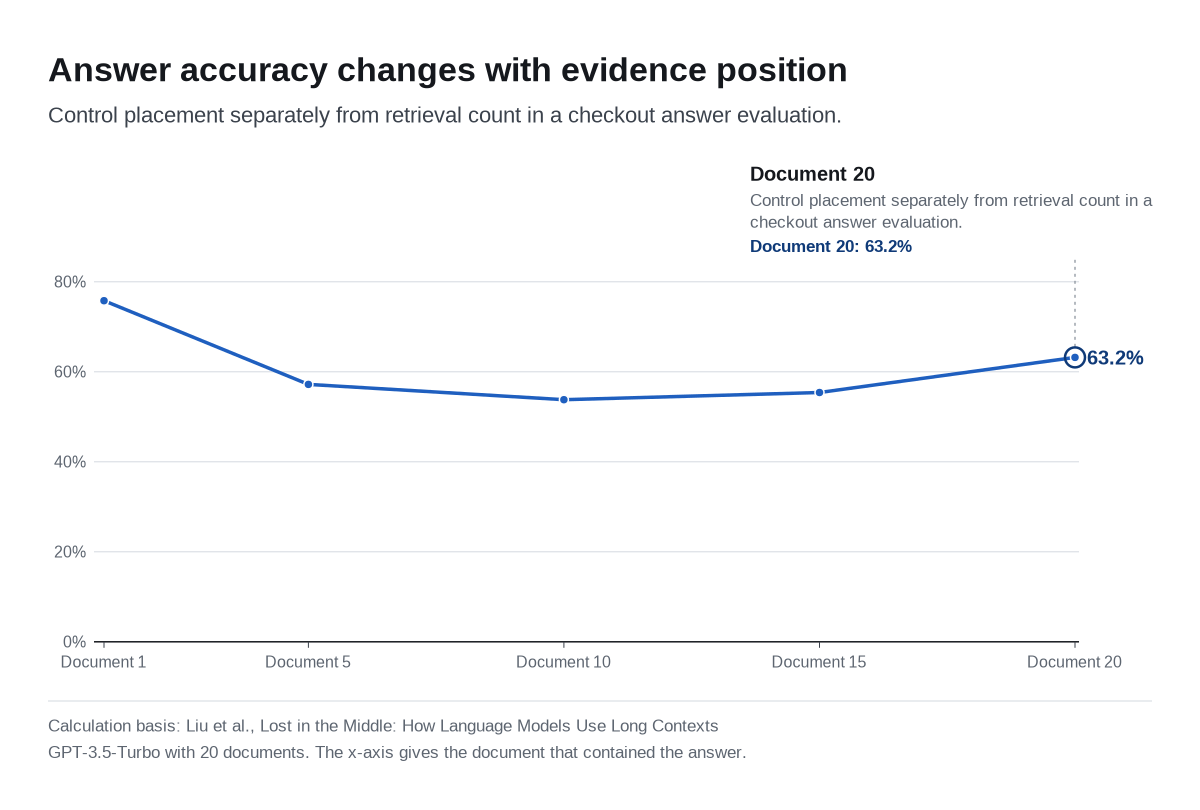
With 20 retrieved documents, GPT-3.5-Turbo scored 75.8% when the answer document came first and 53.8% at position 10. The 22.0-point difference appeared without adding any documents. That makes answer placement a separate checkout test from context length.
Liu et al., Lost in the Middle: How Language Models Use Long Contexts
Key findings and sources
Moving the answer from first to tenth cut the score by 22 points
Thread Recover’s comparison of Lost in the Middle Table 6 finds GPT-3.5-Turbo accuracy of 75.8% at document one and 53.8% at document ten, a 22.0-point difference with 20 retrieved documents.
Liu et al., Lost in the Middle: How Language Models Use Long Contexts
Multi-document question answering in the Lost in the Middle benchmark; TACL 2024 paper, arXiv v3. Subtract accuracy at zero-based index 9 from index 0 for the same model and document count.
Putting the same answer last recovered 9.4 points
In the 20-document Lost in the Middle setting, GPT-3.5-Turbo scored 63.2% when the answer was twentieth and 53.8% when it was tenth, a 9.4-point difference.
Liu et al., Lost in the Middle: How Language Models Use Long Contexts
Multi-document question answering in the Lost in the Middle benchmark; TACL 2024 paper, arXiv v3. Subtract accuracy at index 9 from index 19 within the GPT-3.5-Turbo row.
The 16K configuration still lost 21.6 points at the tenth document
The 16K GPT-3.5-Turbo configuration in Lost in the Middle scored 75.7% with the answer first and 54.1% with it tenth, a 21.6-point gap in the 20-document test.
Liu et al., Lost in the Middle: How Language Models Use Long Contexts
Multi-document question answering in the Lost in the Middle benchmark; TACL 2024 paper, arXiv v3. Compare indices 0 and 9 of the published 16K row.
The tenth document result fell below the closed-book baseline
GPT-3.5-Turbo scored 53.8% with the answer in position ten out of 20, compared with 56.1% on the paper’s closed-book benchmark, 2.3 points lower.
Liu et al., Lost in the Middle: How Language Models Use Long Contexts
Multi-document question answering in the Lost in the Middle benchmark; TACL 2024 paper, arXiv v3. Compare the twentieth-document test’s position-ten score with the model’s closed-book comparison.
Compare the results
Answer accuracy changes with evidence position
Control placement separately from retrieval count in a checkout answer evaluation.
The right passage can be present and still go unused
A shopper asks whether an expedited option arrives before a weekend. The relevant order-specific delivery quote is already in the context, but a long list of historic policies sits around it. The assistant can answer incorrectly even though retrieval found the decisive record.
Liu and colleagues held the document count at 20 and moved the answer passage. GPT-3.5-Turbo was 22.0 percentage points more accurate when that passage was first rather than tenth. The change isolates placement from the amount of material supplied, though ordering may affect models differently.
The longer context version did not erase the position effect
At position 10, the 16K version scored 54.1%, close to 53.8% for the standard version in the same 20-document setup. Its first-to-tenth difference was 21.6 points. A larger advertised context does not establish that a model reliably uses evidence in the middle.
Model differences still matter. Claude 1.3’s first-to-tenth difference was only 3.1 points in this comparison, and its absolute scores were different. That is a reason to measure the store’s own model and prompt assembly rather than copy the size of the historical gap.
Make the quote and its scope hard to miss
Build a fixed set of support prompts with known answers and contradictory or irrelevant neighboring records. Hold the question, answer passage and other documents constant while changing the answer position. Score the claimed delivery date, location or discount condition, and check that the reply used the right record.
Include tests where the record is stale or does not cover the shopper’s address. Moving good evidence closer to the question can help. Moving an unverified promise closer can make the wrong answer easier to produce.
Study data
| Measure | Value |
|---|---|
| GPT-3.5-Turbo, document 1 | 75.8% |
| GPT-3.5-Turbo, document 5 | 57.2% |
| GPT-3.5-Turbo, document 10 | 53.8% |
| GPT-3.5-Turbo, document 15 | 55.4% |
| GPT-3.5-Turbo, document 20 | 63.2% |
| GPT-3.5-Turbo 16K, document 1 | 75.7% |
| GPT-3.5-Turbo 16K, document 5 | 57.3% |
| GPT-3.5-Turbo 16K, document 10 | 54.1% |
| GPT-3.5-Turbo 16K, document 15 | 55.4% |
| GPT-3.5-Turbo 16K, document 20 | 63.1% |
| Claude 1.3, document 1 | 59.9% |
| Claude 1.3, document 5 | 55.9% |
| Claude 1.3, document 10 | 56.8% |
| Claude 1.3, document 15 | 57.2% |
| Claude 1.3, document 20 | 60.1% |
| LongChat 13B, document 1 | 68.6% |
| LongChat 13B, document 5 | 57.4% |
| LongChat 13B, document 10 | 55.3% |
| LongChat 13B, document 15 | 52.5% |
| LongChat 13B, document 20 | 55.0% |
| GPT-3.5-Turbo without retrieval | 56.1% |
| GPT-3.5-Turbo only relevant document | 88.3% |
What changes when you compare the figures
| Comparison | Result | Calculation |
|---|---|---|
| First versus tenth document for GPT-3.5-Turbo | 22.0 percentage points | = 75.8 - 53.8 |
| Twentieth versus tenth document for GPT-3.5-Turbo | 9.4 percentage points | = 63.2 - 53.8 |
| Tenth document versus closed book | -2.3 percentage points | = 53.8 - 56.1 |
| First versus tenth document for the 16K version | 21.6 percentage points | = 75.7 - 54.1 |
| Claude 1.3 first versus tenth document | 3.1 percentage points | = 59.9 - 56.8 |
Methodology and sources
We transcribed Appendix G.2 for the 20-document setting and Table 1 for GPT-3.5-Turbo baselines. The source uses zero-based indices, so we add one when displaying positions. Gaps are arithmetic contrasts of benchmark scores, with no inference about deployment models or commercial conversion.
Download the source data (CSV)
Download the calculations (CSV)
Download the citation notes (CSV)
Related reading
AI Abstention Statistics for Unanswerable Questions
AI multi-turn conversation reliability statistics
AI context length accuracy statistics from the RULER benchmark
Sources and definitions
Liu et al., Lost in the Middle: How Language Models Use Long Contexts
The source data includes the population, period, denominator and limitations for every figure.