


Quick answer
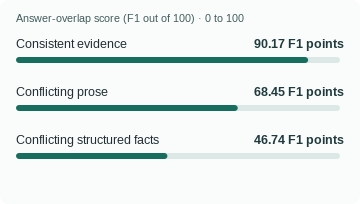
In the 802-item non-complementary setting of ConflictQA, GPT-5.1 scored 90.17 F1 with consistent evidence, 68.45 with conflicting prose and 46.74 with conflicting structured facts. The drop from corrupting structured evidence was about twice as large. Give checkout assistants a verified source for each decision and a clear route when records disagree.
Exploring Knowledge Conflicts for Faithful LLM Reasoning: Benchmark and Method
Key findings and sources
GPT-5.1 under structured and prose evidence conflicts
On ConflictQA’s 802-item non-complementary setting, GPT-5.1 fell from 90.17 F1 with consistent evidence to 46.74 with a structured conflict and 68.45 with a prose conflict. The structured-conflict loss was about twice the prose-conflict loss.
Exploring Knowledge Conflicts for Faithful LLM Reasoning: Benchmark and Method
April 2026 ConflictQA preprint, public general question answering. Subtract the two conflict F1 scores from the common baseline and divide 43.43 by 21.72.
The conflict-format gap varied by model
In ConflictQA’s non-complementary setting, the structured-conflict F1 score was 54.39 points below the prose-conflict score for Qwen3-8B, versus 16.04 points below for GPT-4o.
Exploring Knowledge Conflicts for Faithful LLM Reasoning: Benchmark and Method
802 public questions per condition; selected general models. For each model, subtract TripleConf F1 from TextConf F1.
The gap nearly disappeared when both evidence sources were needed
In ConflictQA’s 430-item complementary setting, GPT-5.1 lost 21.02 F1 points under structured conflict and 20.08 under prose conflict relative to the corresponding consistent baselines, a difference of 0.94 points.
Exploring Knowledge Conflicts for Faithful LLM Reasoning: Benchmark and Method
Complementary questions require both evidence sources for the expected answer. Subtract the Table 3 published F1 losses; the two settings use their respective baselines.
Higher consistent-evidence scores did not guarantee higher scores under conflict
In ConflictQA Table 2, GPT-5.1 scored 1.73 F1 points above GPT-4o with consistent evidence but 7.65 points below it when the structured facts conflicted with the correct prose.
Exploring Knowledge Conflicts for Faithful LLM Reasoning: Benchmark and Method
802-question non-complementary setting; two named model versions. Subtract GPT-4o’s F1 from GPT-5.1’s separately for the two evidence conditions.
Compare the results
A clean-looking field can carry the wrong fact
Suppose a shopper returns to an abandoned checkout and asks if a discount still applies. The conversation contains yesterday’s offer, a help article describes the general terms, and the cart now prices the item at full price. The assistant needs to distinguish what the shopper was told, which policy covers their case and what the cart will actually charge. These are different pieces of evidence. Giving the model all three does not settle which claim it should use.
ConflictQA isolates an analogous problem in public question answering. In its 802-item non-complementary setting, the correct answer can be reached from either structured facts or prose on its own. The authors then make one of those two sources conflict with the correct answer. GPT-5.1 scored 90.17 F1 with consistent evidence. It fell to 46.74 when the structured facts were wrong and 68.45 when the prose was wrong. The two drops were 43.43 and 21.72 F1 points.
Check the conflict type and the model you plan to run
The gap between the two conflict conditions was 21.71 F1 points for GPT-5.1, 16.04 for GPT-4o and 54.39 for Qwen3-8B. Llama-3.1-70B-Instruct scored 46.83 under conflicting structured facts and 63.10 under conflicting prose. These cases compare structured facts with prose on the same benchmark, where either correct source was enough. F1 measures answer overlap, so the figures are unsuitable as percentages of customers given a wrong answer.
When the task requires both sources, the story changes. In the separate 430-item complementary setting, GPT-5.1 fell 21.02 F1 points from the relevant baseline with conflicting structured facts and 20.08 with conflicting prose. The gap between losses shrank to 0.94 points. In a merchant workflow where the policy sets eligibility and a separate order record establishes the shopper’s status, both pieces matter. Resolving one does not complete the answer.
Decide which record owns each fact before sending a reply
Choose a source of truth field by field. The live cart owns the amount and discount currently applied. The effective policy owns whether an exception is available. A carrier or order service may own the latest delivery state. Tie those records to the correct store, cart and shopper and retain the timestamp. If a fresh lookup resolves the conflict, answer from the verified record and acknowledge any earlier different promise where it matters to the shopper.
Build tests where only the order of two disagreeing records changes, where a cached feed is newer-looking but wrong, and where the shopper changed a variant after the assistant last checked. The assistant can explain options while an uncertain action stays pending. If no authoritative record is reachable or a human must honor a prior promise, route the case with the two conflicting values and the shopper’s question intact. This is a testable workflow choice informed by ConflictQA, whose scores do not measure deployed checkout assistants.
Include a control where both records agree. A test that only scores safe escalation can reward an assistant for deferring every answer, even when it could provide a useful delivery quote or resume a verified cart.
Study data
| Measure | Value | Context |
|---|---|---|
| Non-complementary questions per condition | 802 questions | The benchmark reports 802 questions for each non-complementary condition. |
| Complementary questions per condition | 430 questions | The benchmark reports 430 questions for each complementary condition. |
| GPT-5.1 with consistent evidence | 90.17 F1 points | F1 with consistent structured and prose evidence was 90.17. |
| GPT-5.1 with conflicting structured facts | 46.74 F1 points | F1 with conflicting structured facts and correct text was 46.74. |
| GPT-5.1 with conflicting prose | 68.45 F1 points | F1 with conflicting prose and correct structured facts was 68.45. |
| GPT-4o with consistent evidence | 88.44 F1 points | F1 with consistent structured and prose evidence was 88.44. |
| GPT-4o with conflicting structured facts | 54.39 F1 points | F1 with conflicting structured facts and correct text was 54.39. |
| GPT-4o with conflicting prose | 70.43 F1 points | F1 with conflicting prose and correct structured facts was 70.43. |
| Qwen3-8B with consistent evidence | 86.01 F1 points | F1 with consistent structured and prose evidence was 86.01. |
| Qwen3-8B with conflicting structured facts | 21.85 F1 points | F1 with conflicting structured facts and correct text was 21.85. |
| Qwen3-8B with conflicting prose | 76.24 F1 points | F1 with conflicting prose and correct structured facts was 76.24. |
| Llama-3.1-70B-Instruct with consistent evidence | 84.72 F1 points | F1 with consistent structured and prose evidence was 84.72. |
| Llama-3.1-70B-Instruct with conflicting structured facts | 46.83 F1 points | F1 with conflicting structured facts and correct text was 46.83. |
| Llama-3.1-70B-Instruct with conflicting prose | 63.1 F1 points | F1 with conflicting prose and correct structured facts was 63.1. |
| GPT-5.1 structured-conflict F1 loss when both sources are needed | 21.02 F1 points | GPT-5.1 lost 21.02 F1 points versus the corresponding positive baseline under TripleConf. |
| GPT-5.1 prose-conflict F1 loss when both sources are needed | 20.08 F1 points | GPT-5.1 lost 20.08 F1 points versus the corresponding positive baseline under TextConf. |
What changes when you compare the figures
| Comparison | Result | Calculation |
|---|---|---|
| Extra GPT-5.1 loss from structured conflict rather than prose conflict | 21.71 F1 points | = 68.45 - 46.74 |
| Ratio of GPT-5.1 structured-conflict loss to prose-conflict loss | 1.9995 times | = (90.17 - 46.74) / (90.17 - 68.45) |
| Qwen3-8B extra loss under structured conflict | 54.39 F1 points | = 76.24 - 21.85 |
| GPT-4o extra loss under structured conflict | 16.04 F1 points | = 70.43 - 54.39 |
| GPT-5.1 excess structured-conflict loss when both sources are needed | 0.94 F1 points | = 21.02 - 20.08 |
| GPT-5.1 relative to GPT-4o with consistent evidence | 1.73 F1 points | = 90.17 - 88.44 |
| GPT-4o relative to GPT-5.1 under structured conflict | 7.65 F1 points | = 54.39 - 46.74 |
Methodology and sources
We extracted the consistent and conflict-condition F1 results for four general models from ConflictQA’s 802-question non-complementary setting. Each source alone sufficed to answer questions in that setting. TripleConf pairs incorrect structured knowledge-graph facts with correct text; TextConf pairs incorrect text with correct structured facts. Arithmetic comparisons use the printed F1 scores. The benchmark uses public question-answer scenarios, not production store data.
Download the source data (CSV)
Download the calculations (CSV)
Related reading
AI multi-turn conversation reliability statistics
AI context length accuracy statistics from the RULER benchmark
Clarifying question accuracy statistics for AI checkout
Multilingual AI checkout statistics for locale-specific instruction following
Sources and definitions
Exploring Knowledge Conflicts for Faithful LLM Reasoning: Benchmark and Method
The source data includes the population, period, denominator and limitations for every figure.